
12 December 2025
Why 2025 marked a turning point in interior design
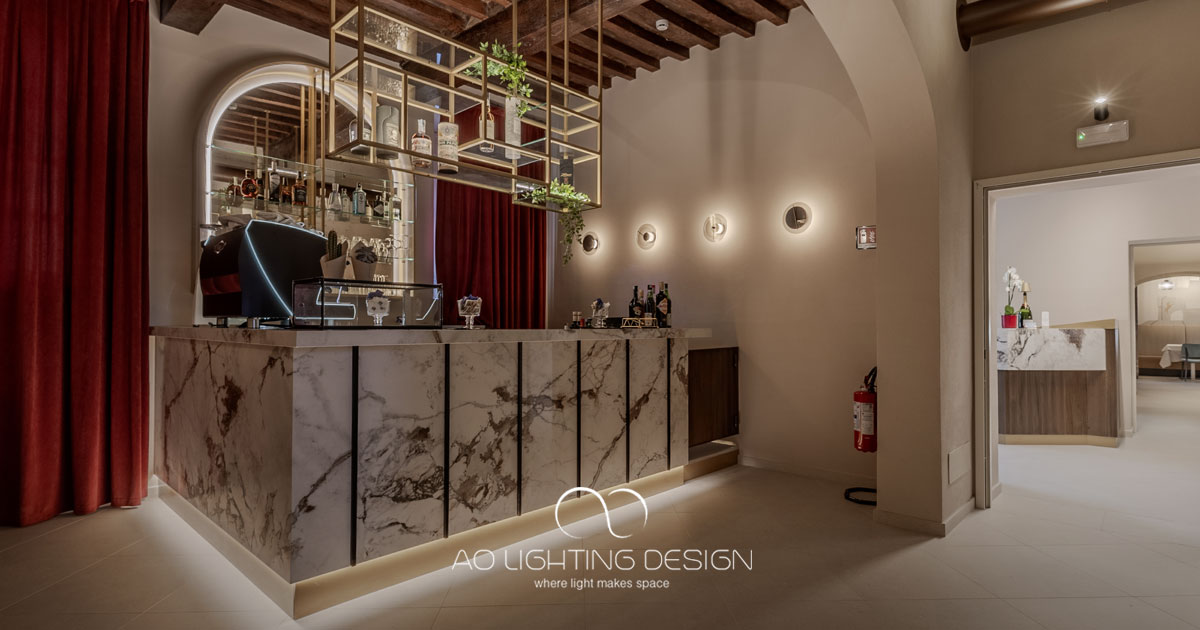
The world of interior design is experiencing a period of profound transformation. While recent years focused on minimalism, the “less is more” approach, and neutral palettes, 2025 has introduced new priorities: sensory experience, synergy between light, form and material, and the integration of invisible technology. For a lighting design studio such as AO, boasting more than twenty years of expertise in commercial, hospitality, residential, and landscape sectors, this transition represents an opportunity to guide clients toward environments that are not only elegant, but deeply experiential and intelligent.
Today’s key concepts include 2025 interior design trends and innovative interior materials, while a broader vision is emerging: the notion of a luminous ecosystem, where light, surface, and technology collaborate to tell a story.
Index
- The main formal and material trends of 2025
• Organic and fluid shapes
• Textural and tactile surfaces
• Technological and smart materials- The role of lighting and sensory experience in interior environments
• Integrated lighting: dimming, home automation, and environmental control
• Application-specific solutions for residential, commercial, and hospitality projects- Innovative interior materials: what to choose today
• Biocomposites and natural-tech materials
• High-tech surfaces (graphene, thin metals, specialty glass)
• Tactile and acoustic cladding for multifunctional spaces- How to design a complete space with AO
• Collaboration with architects, landscapers, and construction companies
• From concept to execution: electrical layout, site supervision, home automation
• Hypothetical case study or standard workflow- Final considerations and outlook: What to expect beyond 2025
- The main formal and material trends of 2025
Organic and fluid shapes
One defining feature of the 2025 interior design trends, is the return of soft, curved, and fluid shapes. We are gradually leaving behind rigid geometric lines in favor of more enveloping volumes, blended surfaces, and unexpected elements inspired by nature and craftsmanship. In premium residential projects, kitchens and islands become fluid sculptural forms; living spaces feature curved and sinuous modules; while in commercial and hospitality environments, corridors and common areas adopt shapes that encourage movement and moments of pause.
For lighting design, this shift requires dedicated attention to integration: curved fixtures, recessed spotlights within rounded volumes, and LED strips following organic profiles.
Textural and tactile surfaces
Alongside form, texture plays a central role. Surfaces become tactile, visually expressive, and perceptibly material: washable yet textured finishes, hand-trowelled stucco, natural fiber wallcoverings, polished or sandblasted stone. The contrast between glossy and matte surfaces, the use of three-dimensional textures, and the emphasis on hand-feel become communication elements in interior selection. Emerging interior materials now combine aesthetics with performance: sound-absorbing upholstered panels, ultra-lightweight recomposed marble, metallic microcements. These require precise lighting design able to enhance texture: grazing light to reveal surface depth, and layered color temperatures to heighten tactility.
Technological and smart materials
Technology enters materials directly: surfaces that change color or transparency, smart glass, perforated thin metals, shape-memory materials. These elements align perfectly with 2025 interior design trends, as they meet both aesthetic and functional needs. Commercial and hospitality environments demand durable, low-maintenance solutions that can integrate with lighting control systems. This is where AO’s expertise becomes decisive, recommending both materials and the most efficient dimming and automation strategies, ensuring compatibility with project platforms.
- The role of lighting and sensory experience in interiors
If material and form define what we see and touch, lighting determines how we experience it. For a lighting designer, these elements form a strategic terrain.
Integrated lighting: dimming, home automation and environmental control
In 2025, light is no longer a decorative detail but an integrated system responding to space usage, circadian rhythm, and presence. A successful lighting design project must include:
• Flexible dimming for intensity and color variation
• Integration with home automation for predefined scenarios (e.g. “welcome home”,
“relax”,“focus”)
• Presence sensors, remote control, app-based management
Thanks to its extensive experience, AO not only selects the most suitable fixtures but also manages cabling design, site supervision, and collaboration with construction teams and system integrators.
Application-specific solutions
• Commercial: brand experience is the goal. Tactile textures, high-tech materials, and
organic forms reflect identity. Lighting strongly enhances visual perception and
functionality (display areas, lounges, directional paths).
• Hospitality: spaces must transform quickly: from relaxation to social interaction. Durable
surfaces and flexible lighting are essential. AO’s control systems enable dynamic lighting
scenarios.
• Landscape: interior design connects with the outdoors, materials continue outside, light
guides views outward and vice versa. AO manages both indoor and outdoor electrical
layouts in line with an «indoor-outdoor philosophy».
• Residential: personalisation is key. Lighting becomes emotional, guiding users from living to
nighttime spaces. Innovative materials meet slim LED fixtures, integrated panels, and ceiling
profiles defining volumetrics.
3. Innovative interior materials: what to choose today
When it comes to innovative interior materials, we focus on three main categories that are emerging strongly.
Biocomposites and natural-tech materials
The connection to nature is a consolidated trend, but in 2025 it takes concrete form through hybrid materials: reinforced natural fibers, recomposed wood, and 3D-printed bioplastics. These finishes express sustainability and pair perfectly with premium environments supported by expert lighting. Examples: hemp–cement panels, acid-etched glass with bio-resin inserts, high-tech wooden flooring. Lighting reveals the tactile identity of these surfaces.
High-tech surfaces. Graphene, thin metals, specialty glass
Materials once limited to industrial sectors now enter interior design: graphene for conductive anti-static surfaces, microperforated metals for panels, smart glass that modulates opacity or color. These solutions require technical lighting planning and regulation. AO excels in fixture selection, thermal management, wiring layout, and domotic integration.
Tactile and acoustic cladding for multifunctional environments
Today’s spaces are fluid: living rooms become offices, lounges evolve into event areas. Materials must deliver multiple functions: aesthetic value, tactile response, acoustic absorption, adaptability. Examples include sound-absorbing textured panels, microcement slabs engineered for insulation, and integrated rugs in steps or seating modules.
Lighting here must be adaptable and integrated: LED strips framing surfaces, concealed fixtures enhancing texture and usability.
4. How to design a complete space with AO
Let’s now look at a practical approach, designed for architects, businesses, and end customers, where lighting, materials, and form meet.
Collaboration with architects, landscapers and construction teams
AO acts as a technical–creative partner throughout the project phases:
• Design brief with architect or landscape designer: style, material strategy, lighting palette
• Context analysis (commercial/residential/hospitality) and functional scenario planning
• Selection of innovative materials and suitable lighting equipment
• Coordination with construction teams for electrical routing and fixture installation
From concept to execution: electrical layout, site supervision, home automation
AO oversees the entire process:
• Circuit distribution diagrams and dimming systems, in collaboration with integrators
• Site supervision: installation checks, alignment of materials with lighting intent, scenario
testing
• Training for light management: remote control, scenarios, maintenance. This ensures not
just light installation, but a coherent ecosystem of innovative materials, forms, and lighting.
Hypothetical case study
Consider a hospitality project aiming to adopt 2025 interior design trends. Fluid shapes define the lobby, tactile finishes enhance relaxation areas, smart glass is used in conference rooms. AO collaborates with the architect and general contractor, designing lighting layouts, demonstrating the power of grazing light, programming day-to-night scenarios, and coordinating installation. The result is a coherent, elegant, and technologically advanced environment.
- Final considerations and outlook: what to expect beyond 2025
2025 interior design trends indicate that interior projects must go beyond aesthetics and functionality to become integrated environmental experiences. Innovative interior materials, advanced lighting strategies, and intelligent automation deliver both aesthetic and emotional value. For architects, interior designers, and clients, working with a specialized partner like AO means embracing this transformation and shaping a holistic vision where light, form, and material operate in unity.
Looking beyond 2025, we expect:
Spaces will evolve into mood-responsive environments, with lighting and surfaces adapting to users and emotions. Recomposed and smart materials will become mainstream. Lighting will be fully connected, integrated, and invisible: digital infrastructure rather than visible fixtures. In this evolving landscape, AO is positioned as a leading player: expert, versatile, and capable of transforming creative vision into technical and high-performing reality. Contact our team to develop your next project.

Every project is an ongoing dialogue between creative vision and technical expertise, designed to bring to life lighting experiences that are coherent, sustainable, and impactful. If you’re developing a project and are looking for a partner who combines design, technology, and architectural sensitivity, contact us: the right light can change everything.
Latest articles
Sustainable design solutions for commercial buildings
The strategic role of lighting design in green commercial architecture. Sustainable design and commercial spaces In recent years, the concept of sustainable building design has undergone a profound evolution. It is no longer solely about reducing energy consumption or complying with environmental regulations …
Designing Green Urban Spaces: The Role of Landscape Architecture in the City of Tomorrow
Why Urban Green Spaces Are Essential Today’s cities face complex challenges: population growth, densification, traffic, climate change, and pressure on public spaces. In this context, urban green spaces represent far more than an aesthetic element …

AO at LiGHT Expo London 2025: Illuminating with Vision, Technology and Sustainability
The LiGHT Expo 2025 took place on November 19–20, 2025, offering two days entirely dedicated to innovation in the art of lighting design.The event was held at the Business Design Centre in Islington, London, a landmark venue for design and architecture...