
5 March 2026
Light as a strategic lever in hospitality projects
In today’s hospitality landscape, experience is the true competitive differentiator. Delivering excellent service is no longer enough; spaces must be designed to convey identity, emotion, and narrative coherence.
Within this context, light plays a pivotal role. It is not a technical element to be added at the end of a project, but a strategic tool that influences:
- The perception of materials
- Human behavior
- Length of stay
- Perceived brand quality
A project that genuinely seeks to unite aesthetics and functionality must integrate lighting design from the earliest conceptual stages.
Index
- AO and lighting design as a partner to architecture
- The Albert’s Champagne Bar project: context and objectives
- Lighting concept: inspiration, atmosphere, and identity
- Aesthetics and functional design: integration into the multifaceted ceiling
- User experience and spatial perception
- Sustainability and energy efficiency
- Why this is a successful architectural case study
- Conclusions
- 1. AO and lighting design as a partner to architecture
AO operates as a strategic partner in architectural and interior projects, with a vertical focus on:
- Lighting design for retail, hospitality, and corporate environments
- Designing spatial experiences through light
- Consulting on the impact of lighting on brand perception and performance
- Integration of light, architecture, and identity
- Sustainability and energy efficiency
AO does not design buildings from a structural standpoint. Instead, it works in synergy with architects and interior designers to enhance spaces through functional design capable of generating measurable value.
A concrete example of this approach is the Albert’s Champagne Bar project.
- The Albert’s Champagne Bar project: context and objectives
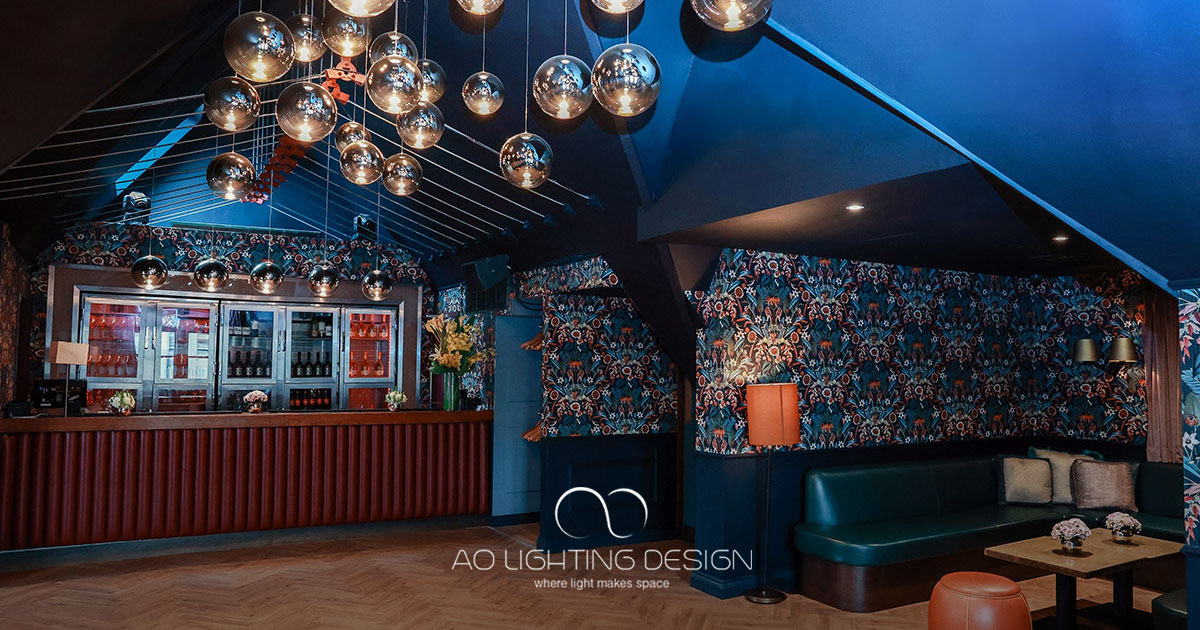
This case study focuses on Albert’s Champagne Bar, located within the prestigious Beaufort House in London, in the district of Chelsea.
The objective was to transform the top floor of the building into an exclusive champagne destination capable of expressing:
- Sophistication
- Intimacy
- Contemporary elegance
- Alignment with a premium positioning
The brief was not simply to illuminate a space, but to create a distinctive atmosphere that embodied the venue’s spirit. Light needed to become an integral part of the narrative.
- Lighting concept: inspiration, atmosphere, and identity
The concept developed by AO draws inspiration from a symbolic element: the perlage of champagne.
The bubbles become both a visual and narrative metaphor. This inspiration translates into a lighting system integrated into the multifaceted ceiling, generating a sense of dynamism and lightness.
The design approach is structured around three key drivers:
3.1 Luminous storytelling. Light interprets the identity of the venue. It is not neutral; it actively shapes the atmosphere through:
- Warm tones to encourage intimacy
- Targeted accents to highlight the bar counter
- Controlled contrasts to create depth
3.2 Visual hierarchy. Effective and functional design naturally guides the eye. In this project:
- The bar becomes the luminous focal point
- Tables receive calibrated lighting for comfort and conviviality
- Circulation paths are intuitive and fluid
3.3 Architectural integration. The solution does not dominate the space; it completes it. The lighting fixtures engage in dialogue with the geometric ceiling, enhancing its three-dimensional quality.
- Aesthetics and functional design: integration into the multifaceted ceiling
This project represents a perfect balance between scenographic impact and functional design.
4.1 Operational function. The lighting ensures:
- Optimal visibility for staff
- Visual comfort for guests
- Uniformity in service areas
Each light point is carefully calibrated to meet practical requirements without compromising the atmosphere.
4.2 Scenic effect. The integration within the ceiling creates a dynamic, almost vibrant effect. Light reflects across surfaces, generating an ongoing dialogue between materials and geometry. The result is a space whose perception shifts depending on the viewpoint and time of day.
4.3 Flexibility. A defining feature of any successful architectural case study is adaptability. The lighting design allows for variations in intensity and scenario settings, enabling the venue to transform according to time or event.
- User experience and spatial perception
In hospitality, experience is shaped by perceptual micro-details.
5.1 Visual comfort. The lighting avoids glare and excessive contrast. Guests perceive a refined yet welcoming environment.
5.2 Material enhancement. Surfaces, textures, and reflections are coherently emphasized. Champagne itself becomes a visual protagonist.
5.3 Dwell time and engagement. A well-lit environment encourages longer stays. Light helps create a setting in which time appears to slow down, fostering consumption and social interaction.
This demonstrates how lighting design directly influences spatial performance.
- Sustainability and energy efficiency
Even in a project with a strong aesthetic component, sustainability remains central.
The lighting design includes:
- High-efficiency LED sources
- Optimization of illuminance levels
- Reduced energy consumption
- Long component lifespan
Sustainability is not merely technical; it is strategic. Reducing energy impact enhances operational management and strengthens brand reputation.
- Why this is a successful architectural case study
Albert’s Champagne Bar represents a compelling architectural case study that successfully unites aesthetics and functionality because:
- Lighting is integrated from the conceptual phase
- Brand identity drives design decisions
- Architecture is enhanced rather than overshadowed
- Functional design responds to real operational needs
- Energy efficiency is embedded in the overall strategy
The project demonstrates how lighting can act as a transformative element, elevating perceived quality and generating tangible value.
- Conclusions
In hospitality, balancing form and function is key to long-term success. The Albert’s Champagne Bar case highlights how an integrated approach to lighting design can:
- Strengthen brand identity
- Enhance user experience
- Optimize operational performance
- Ensure long-term sustainability
A project that unites aesthetics and functional design does not emerge from isolated decisions, but from a strategic vision that places light at the heart of the creative process.
AO demonstrates that light is not a technical detail, but a design lever capable of transforming a space into an experience, a narrative, and a source of competitive advantage.

Ogni progetto è un dialogo continuo tra visione creativa e competenza tecnica, per dare vita a esperienze luminose coerenti, sostenibili e di impatto. Se stai sviluppando un progetto e desideri un partner che unisca design, tecnologia e sensibilità architettonica, contattaci: la luce giusta può cambiare tutto.
Articoli recenti
Sustainable design solutions for commercial buildings
The strategic role of lighting design in green commercial architecture. Sustainable design and commercial spaces In recent years, the concept of sustainable building design has undergone a profound evolution. It is no longer solely about reducing energy consumption or complying with environmental regulations …
Designing Green Urban Spaces: The Role of Landscape Architecture in the City of Tomorrow
Why Urban Green Spaces Are Essential Today’s cities face complex challenges: population growth, densification, traffic, climate change, and pressure on public spaces. In this context, urban green spaces represent far more than an aesthetic element …

AO at LiGHT Expo London 2025: Illuminating with Vision, Technology and Sustainability
The LiGHT Expo 2025 took place on November 19–20, 2025, offering two days entirely dedicated to innovation in the art of lighting design.The event was held at the Business Design Centre in Islington, London, a landmark venue for design and architecture...